


Our Vision
Everyone deserves access to mental health care that actually sees them. And holds them in all their humanity.
Why Sol Exists
DATE: APR 8, 2026
AUTHOR: MELINDA GONG
READING TIME: 5 MIN
Investment in mental health has never been higher. The conversation has never been louder. And yet something essential is still missing, as measures of human flourishing, social belonging, and emotional health continue to decline. Depression is rising, loneliness has reached epidemic levels, and the quiet sense of truly belonging, of being held by something larger than yourself, is eroding in ways that no platform or technological breakthrough has reversed. The U.S. Surgeon General has named social isolation as one of the strongest predictors of early mortality. Suicide remains one of the leading causes of death for young people. These are not isolated tragedies. They describe a cultural condition.
The world we inherited is heavy. Post-pandemic, geopolitically fractured, economically unstable. And we adapted the way humans do. We stayed busy. We live from our shoulders up: overstimulated, overextended, in a constant state of low-grade activation that we know as normal. We cope by staying busy, by consuming, and by scrolling past discomfort rather than sitting with it. Pain that is never metabolized doesn't disappear. It lives in the body. It waits.
Into this landscape, AI has arrived, fluent, responsive, available at any hour, and we're observing a slow and dangerous psychological reshaping in how we relate to one another. When something hard happens, we may reach for a tool (our phones, a chatbot), instead of a friend. We are outsourcing our discomfort instead of sitting with it, avoiding difficult conversations instead of having them, numbing instead of feeling. And what makes this so insidious is that it doesn't feel like loss; it feels like relief. But diffusely, at a societal level, we are being rewired. We are losing our tolerance for the friction that real relationships require, our capacity to be truly known by another person, our instinct to turn toward each other when things get hard. AI can simulate presence. It cannot provide it.
Beneath all of it, there is a collective yearning to return to human connection, to social belonging, to community. To having someone be truly present with you. We believe the antidote to all of it is each other.
The world we inherited is heavy. Post-pandemic, geopolitically fractured, economically unstable. And we adapted the way humans do. We stayed busy. We live from our shoulders up: overstimulated, overextended, in a constant state of low-grade activation that we know as normal. We cope by staying busy, by consuming, and by scrolling past discomfort rather than sitting with it. Pain that is never metabolized doesn't disappear. It lives in the body. It waits.
Into this landscape, AI has arrived, fluent, responsive, available at any hour, and we're observing a slow and dangerous psychological reshaping in how we relate to one another. When something hard happens, we may reach for a tool (our phones, a chatbot), instead of a friend. We are outsourcing our discomfort instead of sitting with it, avoiding difficult conversations instead of having them, numbing instead of feeling. And what makes this so insidious is that it doesn't feel like loss; it feels like relief. But diffusely, at a societal level, we are being rewired. We are losing our tolerance for the friction that real relationships require, our capacity to be truly known by another person, our instinct to turn toward each other when things get hard. AI can simulate presence. It cannot provide it.
Beneath all of it, there is a collective yearning to return to human connection, to social belonging, to community. To having someone be truly present with you. We believe the antidote to all of it is each other.
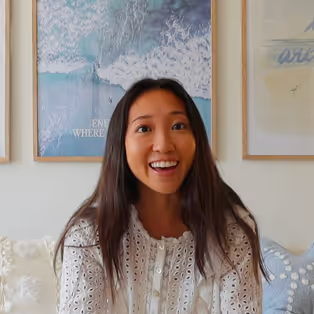
My story
I always knew I would end up here. I didn't have the language for it early on, but I felt it.
I grew up training to go professional in ballet, a world that gets deep inside your head. It made me intensely curious about human psychology, about why people struggle long before they ever say anything out loud. At Stanford, I studied the intersection of computer science, psychology, and the human condition.
At the end of my sophomore year, I lost my brother Tony to suicide after a long battle with depression. Everything I knew about the world changed in an instant. Grief sobers you up and strips everything down to what actually matters. And it was my first real encounter with the mental health system. I was met with month long waitlists, high out-of-pocket costs, and multiple therapists who didn't quite understand me.
I did find a therapist who changed my life. But I couldn't shake what I was observing around me: care that felt cold, intimidating, and sterile, rather than warm and relational, and therapists burning out—before they're fully licensed—as they are expected to hold the collective traumas that they too are experiencing.
Most of us were never given the language to talk about what's going on in our inner world. Sometimes what we carry has a clean clinical name: [anxiety, depression, ADHD, trauma]. But sometimes it doesn't. It's [loneliness, languish, feeling misunderstood, high functioning burnout wearing the veneer of ambition, a quiet heartbreak]. I wanted to create a space that would give people that vocabulary.
These observations became the foundation for Sol.
I grew up training to go professional in ballet, a world that gets deep inside your head. It made me intensely curious about human psychology, about why people struggle long before they ever say anything out loud. At Stanford, I studied the intersection of computer science, psychology, and the human condition.
At the end of my sophomore year, I lost my brother Tony to suicide after a long battle with depression. Everything I knew about the world changed in an instant. Grief sobers you up and strips everything down to what actually matters. And it was my first real encounter with the mental health system. I was met with month long waitlists, high out-of-pocket costs, and multiple therapists who didn't quite understand me.
I did find a therapist who changed my life. But I couldn't shake what I was observing around me: care that felt cold, intimidating, and sterile, rather than warm and relational, and therapists burning out—before they're fully licensed—as they are expected to hold the collective traumas that they too are experiencing.
Most of us were never given the language to talk about what's going on in our inner world. Sometimes what we carry has a clean clinical name: [anxiety, depression, ADHD, trauma]. But sometimes it doesn't. It's [loneliness, languish, feeling misunderstood, high functioning burnout wearing the veneer of ambition, a quiet heartbreak]. I wanted to create a space that would give people that vocabulary.
These observations became the foundation for Sol.

Starting at the root
The mental health care system has a supply problem that rarely gets named directly: we do not have enough therapists. Demand for mental health care is at an all-time high, and the supply of licensed providers has not kept pace. We are facing a nationwide therapist shortage, and until we fix that, access will remain out of reach for most people who need it.
The root of that shortage runs deeper than most people realize. To become a licensed therapist, graduate clinicians spend years completing thousands of supervised clinical hours, hours that are often unpaid, poorly supervised, underresourced, leading to an unsustianable and depleting entrance into the field. The research bears this out: 57% of graduate therapists abandon their careers before they ever reach licensure.
We believe access alone will not close the mental health gap. Quality comes first. Quality starts with the person in the room: a therapist who is rigorously trained, closely supervised, fairly compensated, and genuinely held in the arc of their own development.
Sol was built from this conviction. We are a placement site, a training ground, and a home for the next generation of emerging therapists. Every therapist at Sol receives weekly one-on-one supervision from a licensed therapist with at least five years of clinical experience, structured clinical training grounded in evidence-based practice, and real investment in their growth as a therapist.
We believe the quality of our therapists is non-negotiable, and so we maintain a 25% acceptance rate. We invest in the full arc of becoming a therapist, from first session to licensure, and beyond. When a therapist is genuinely supported, their clients feel the difference.
The root of that shortage runs deeper than most people realize. To become a licensed therapist, graduate clinicians spend years completing thousands of supervised clinical hours, hours that are often unpaid, poorly supervised, underresourced, leading to an unsustianable and depleting entrance into the field. The research bears this out: 57% of graduate therapists abandon their careers before they ever reach licensure.
We believe access alone will not close the mental health gap. Quality comes first. Quality starts with the person in the room: a therapist who is rigorously trained, closely supervised, fairly compensated, and genuinely held in the arc of their own development.
Sol was built from this conviction. We are a placement site, a training ground, and a home for the next generation of emerging therapists. Every therapist at Sol receives weekly one-on-one supervision from a licensed therapist with at least five years of clinical experience, structured clinical training grounded in evidence-based practice, and real investment in their growth as a therapist.
We believe the quality of our therapists is non-negotiable, and so we maintain a 25% acceptance rate. We invest in the full arc of becoming a therapist, from first session to licensure, and beyond. When a therapist is genuinely supported, their clients feel the difference.
What We Are
Sol is not just a marketplace or a matching algorithm. It is an ecosystem built around a single belief: we heal in relationship. Not through a tool, but through another human being who shows up for you as a teammate and an anchor. Session after session, for as long as the work takes.
At a user's every interaction with Sol, we are asking: how do we want our users to feel? Safe, warm, and supported. Like there is no right or wrong way to be human, only your most authentic way. We are all on our own unique node in our human journey, just trying to figure out how to show up as fully ourselves.
Our Sol Care Model holds all of you: physical, mental, emotional, relational, spiritual. None of these parts exist in isolation from the others. We work at that integrated layer, not just treating what's on the surface but excavating what's underneath it.
We live in a world that hands you a frictionless way out of every uncomfortable feeling. Sol does the opposite. We help you stay and develop the capacity to remain present with what is difficult, because that is where something actually changes.
92% of Sol clients experience measurable improvements in anxiety and depression symptoms within their first month. Behind every one of those data points is a person who decided to stay with something hard long enough for it to shift.
At a user's every interaction with Sol, we are asking: how do we want our users to feel? Safe, warm, and supported. Like there is no right or wrong way to be human, only your most authentic way. We are all on our own unique node in our human journey, just trying to figure out how to show up as fully ourselves.
Our Sol Care Model holds all of you: physical, mental, emotional, relational, spiritual. None of these parts exist in isolation from the others. We work at that integrated layer, not just treating what's on the surface but excavating what's underneath it.
We live in a world that hands you a frictionless way out of every uncomfortable feeling. Sol does the opposite. We help you stay and develop the capacity to remain present with what is difficult, because that is where something actually changes.
92% of Sol clients experience measurable improvements in anxiety and depression symptoms within their first month. Behind every one of those data points is a person who decided to stay with something hard long enough for it to shift.
We are lifelong students of the human soul. We stand for relationality over transactionality. And we believe that in a world moving faster than we were designed to live in, the most radical thing we can offer is connection: one person fully present with another, holding you in all your humanity.
Sol is where you land.
Melinda Gong
Co-Founder, Sol Health
melinda@solhealth.co
Co-Founder, Sol Health
melinda@solhealth.co

%202.avif)



For 24/7 crisis support, text 741741 to reach the Crisis Text Line, or call 988 to reach the National Suicide and Crisis Lifeline.

